
Home of the Classic Car
Barndominium Builders in Auburn, IN
DeKalb County's code snow load is half again what Allen County's is. A barndo roof here gets designed for it.
- Site visit before any pricing
- Written, line-item estimates
- County code and septic research included
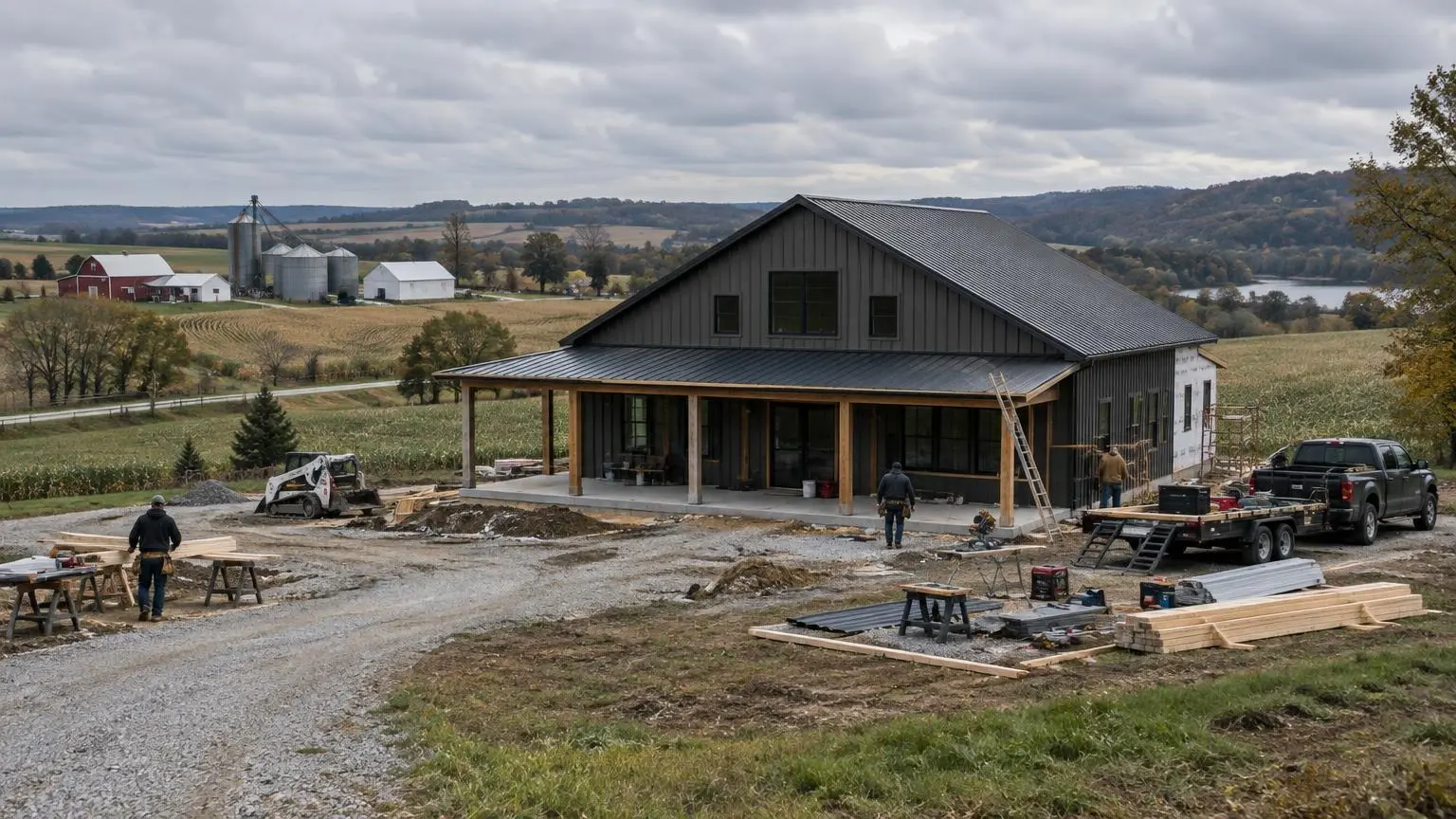
Designing a Barndominium for DeKalb County Winters
Barndominium builders in Auburn plan around one number before almost any other: 30. The 2020 Indiana Residential Code lists DeKalb County at a 30 psf ground snow load, higher than the 20 psf listed for Allen County just to the south and for counties such as Montgomery, Vigo, Knox and Floyd. Auburn is the DeKalb County seat, about 20 miles north of Fort Wayne, with 13,412 residents at the 2020 census. The county grew from 42,223 in 2010 to 43,265 in 2020, and Wikipedia describes its terrain as low and rolling, used entirely for agriculture or urban development. Farm parcels around Auburn and Garrett are a natural home for a shop-and-house building.
Winter, by the numbers
Auburn averages about 32.4 inches of snow a year, and the 1981-82 season brought 67.5 inches. The record low is -24 F, set on January 21, 1984, and the average January low is about 17 F. The county code values reflect that:
- 30 psf ground snow load
- 36-inch minimum footing depth below finished grade
- 1 F winter design temperature
- Ice-barrier underlayment required
- 115 mph design wind and seismic design category A
What that means for the roof
A barndominium's roof is wide and often low-pitched, and it covers both living space and a shop. Snow load sets the size and spacing of trusses or rafters, purlins and the connections that carry them. A few design points we focus on in DeKalb County:
- Drifting. Where a lower lean-to or porch roof meets a taller main roof, snow slides and drifts onto the lower roof. Those areas are designed for more than the base load.
- Shed zones. Metal roofs shed snow suddenly. Entry doors, walkways and overhead shop doors should not sit under a shedding eave without protection.
- Ice dams. The code requires an ice barrier here. A well-insulated, well-sealed ceiling keeps heat out of the roof deck so meltwater doesn't refreeze at the eaves.
- Clear spans. Wide open shop bays under heavy snow need deeper trusses or a steel frame designed for the load, which can affect ceiling height inside.
What that means for the foundation
At 36 inches, DeKalb County's listed footing depth is a foot deeper than the 24 inches listed for southern Indiana counties. On a post-frame building that sets how deep posts or footing pads go; on a slab-on-grade steel building it sets the depth of the perimeter footing or the design of a frost-protected shallow foundation. Soils matter here too. Glynwood, a soil the USDA maps across northern Indiana on Wisconsinan moraines, is moderately well drained with slow permeability in the dense till below and a perched water table 1 to 2 feet down from January to April. Wet, cold soil is exactly where frost heave happens, so we pay attention to drainage around the footings as much as their depth.
Water: creeks, the St. Joe and the drainage board
Auburn sits on Cedar Creek, which drains the western part of the county. The St. Joseph River flows southwest through the county's southeast corner on its way to Fort Wayne, where it meets the St. Marys to form the Maumee. In DeKalb County, the Board of Commissioners also serves as the county drainage board, and the Surveyor's office calculates drainage assessments. On flat farm ground crossed by county drains, we find out early where regulated drains run and how they affect where the building and septic field can go.
County offices involved
DeKalb County's website lists a Development Services, Plan Commission, GIS and Building department. The Plan Commission is the county's zoning authority, and a Plat Committee reviews land divisions. For septic, the DeKalb County Health Department in Auburn handles septic information, permitting, inspections and complaints, under Indiana's residential onsite rule, 410 IAC 6-8.3. Where a sanitary sewer is reasonably available, the state program requires connection instead of septic.
A little local history
Auburn was settled in 1836 where the Goshen-Defiance and Coldwater trails crossed, and became a city in 1900. The Auburn Automobile Company built its first car there in 1903 and closed in 1937, and the Auburn Cord Duesenberg Automobile Museum is now a National Historic Landmark. A heated, well-lit shop bay for a collector vehicle is one of the things a barndominium layout handles well.
High ground
The county's highest point is about 1,060 feet, a small rise roughly two miles west of Fairfield Center in the northwest. Auburn itself sits at about 863 feet.
Have land around Auburn or elsewhere in DeKalb County? Call (317) 893-3806 or
and we'll start with the snow and the drains.DeKalb County Design Values
- Snow load. The 2020 Indiana Residential Code lists DeKalb County at a 30 psf ground snow load, with ice-barrier underlayment required.
- Footing depth. DeKalb County's listed minimum footing depth is 36 inches below finished grade.
- Snow record. Auburn averages about 32.4 inches of snow a year; the 1981-82 season brought 67.5 inches.
- Drainage board. DeKalb County's Board of Commissioners also serves as the county drainage board.
- Zoning authority. The DeKalb County Plan Commission is the county's zoning authority; the Health Department handles septic permitting and inspections.
Auburn Questions
What snow load is a barndominium roof designed for in DeKalb County?
The state code lists a 30 psf ground snow load for DeKalb County. Drift areas next to taller roofs are designed for more.
How deep do footings go around Auburn?
The code lists 36 inches below finished grade as the minimum for DeKalb County.
There's a county drain across my field. Is that a problem?
Not necessarily, but it affects where you can build. In DeKalb County the commissioners serve as the drainage board, so we check drain locations early.
Who issues the septic permit?
The DeKalb County Health Department in Auburn handles septic permitting and inspections.
Barndominium Builders Near Auburn
- Barndominium Builders in Indianapolis, IN
- Barndominium Builders in Noblesville, IN
- Barndominium Builders in Westfield, IN
- Barndominium Builders in Greenwood, IN
- Barndominium Builders in Franklin, IN
- Barndominium Builders in Martinsville, IN
- Barndominium Builders in Bloomington, IN
- Barndominium Builders in Columbus, IN
- Barndominium Builders in Seymour, IN
- Barndominium Builders in Shelbyville, IN
- Barndominium Builders in Greenfield, IN
- Barndominium Builders in Anderson, IN
- Barndominium Builders in Muncie, IN
- Barndominium Builders in Richmond, IN
- Barndominium Builders in Kokomo, IN
- Barndominium Builders in Lafayette, IN
- Barndominium Builders in Crawfordsville, IN
- Barndominium Builders in Terre Haute, IN
- Barndominium Builders in Vincennes, IN
- Barndominium Builders in Evansville, IN
- Barndominium Builders in Jasper, IN
- Barndominium Builders in New Albany, IN
- Barndominium Builders in Fort Wayne, IN
- Barndominium Builders in Warsaw, IN
- Barndominium Builders in Goshen, IN
- Barndominium Builders in Elkhart, IN
- Barndominium Builders in South Bend, IN
- Barndominium Builders in Plymouth, IN
- Barndominium Builders in Valparaiso, IN