
Indiana's oldest town, between two rivers
Barndominium Builders in Vincennes, IN
Knox County is bounded by the Wabash and the White. Where your land sits between them decides the build.
- Site visit before any pricing
- Written, line-item estimates
- County code and septic research included
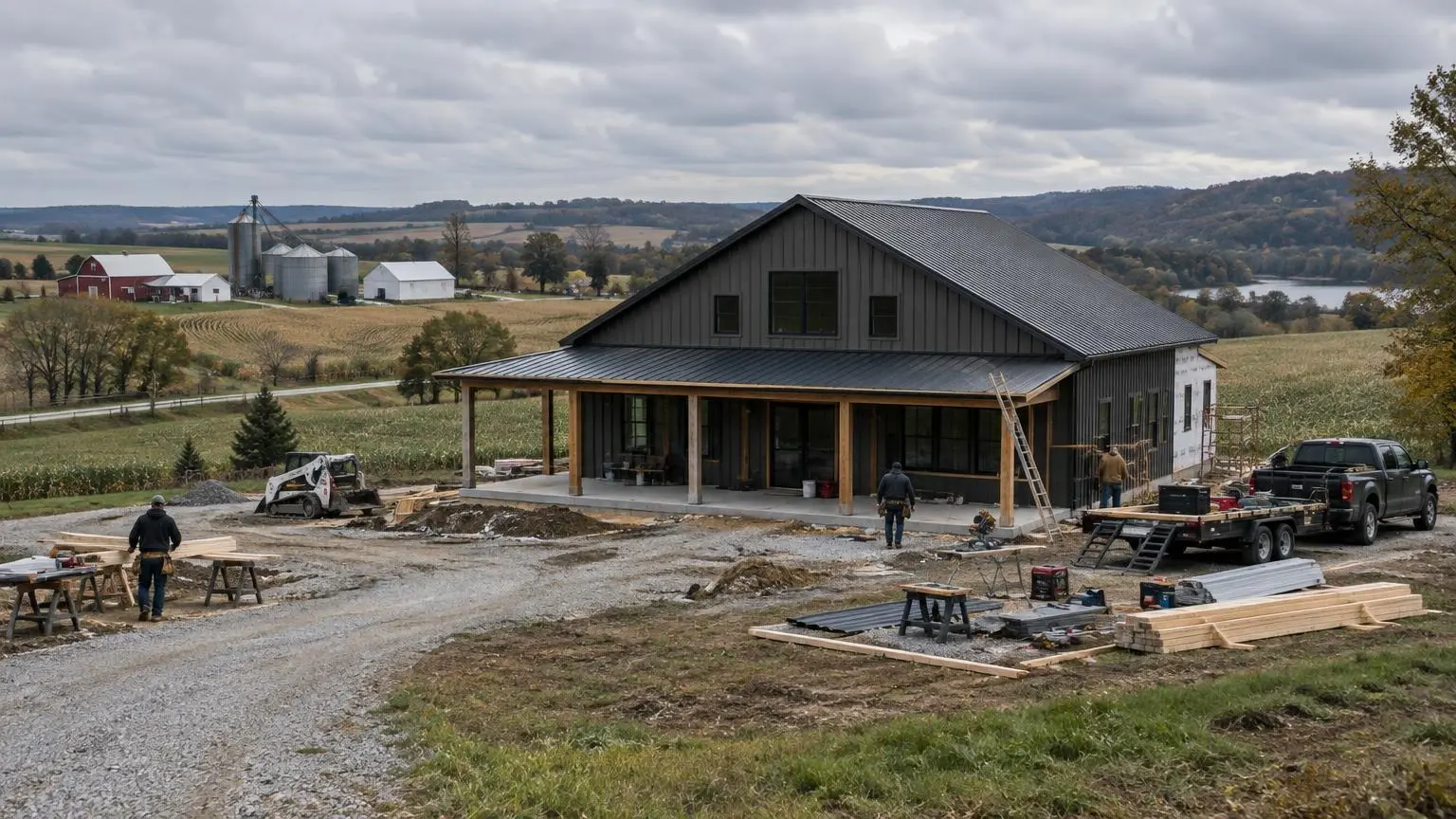
Reading Knox County Ground for a Barndominium
Barndominium builders in Vincennes work in the oldest continually inhabited European settlement in Indiana, founded by French fur traders in 1732 and the territorial capital from 1800 to 1813. The city sits on the lower Wabash at the western edge of Knox County, about 100 miles southwest of Indianapolis and roughly halfway between Evansville and Terre Haute, with Illinois across the river. It had 16,759 residents in 2020, down from 18,423 in 2010, and Knox County had 36,282. Wikipedia describes the county as mostly low rolling hills in agricultural use, historically known for orchards.
What makes Knox County unusual is that several official USDA soil series have their type location here. Three of them, line up neatly with the three kinds of land you are likely to look at. Each one points to a different way of building.
Land type 1: Low terraces near the big rivers
The Vincennes series is named for the city. The USDA describes it as a poorly drained, slowly permeable soil formed in water-laid loamy sediments on nearly level low terraces along larger streams, with slopes of 2 percent or less. The description includes a flooded phase and notes that floodplain soils such as Ross, Haymond, Genesee and Cuba sit on the lower ground next to it. On this kind of land:
- Pull the FEMA flood map before you make an offer
- Expect to raise the pad and bring in compacted fill
- If any of the footprint is in a flood hazard area, the Indiana Residential Code puts the design flood elevation at base flood elevation plus two feet
- Plan the septic system with the seasonal wetness in mind, because a poorly drained soil limits conventional absorption fields
Land type 2: Rolling loess hills
The Alford series has its type location in Knox County near Fritchton, on a gentle cultivated slope at about 560 feet. It is a well-drained soil formed in loess, found on the summits, shoulders and backslopes of loess hills, and it is of large extent across southwestern and west-central Indiana. This is usually the easiest ground for a barndominium: good drainage, workable soil and natural fall away from the slab. The cautions are erosion on steeper slopes and making sure a big roof's runoff is carried off without cutting the hillside.
Land type 3: Hilltops with a hardpan
The Hosmer series, described from a site about a mile and a half northeast of Frichton, is also a loess-hill soil, but it has a dense fragipan starting 20 to 36 inches down. Water moves slowly through and below the pan, and the USDA notes a perched water table 1.5 to 2.5 feet deep, typically from December through April. On Hosmer-type ground we pay close attention to:
- Footing drains or perimeter tile where water could sit against the foundation in late winter
- Septic design, since the pan and the perched water both limit absorption depth
- Grading the pad high enough that spring water moves away rather than under
The two rivers
Knox County's west border is the Wabash, flowing south, and its east border is the White River, flowing south-southwest. They meet at the county's southwestern tip near Mount Carmel, Illinois. Vincennes sits near Wabash river mile 441, on a bend that once let it control river traffic, and the Embarras River joins the Wabash about four miles west of the city. Bottomland is part of almost every conversation about land here.
Code numbers for Knox County
The 2020 Indiana Residential Code lists Knox County at a 24-inch minimum footing depth, a 20 psf ground snow load, a 115 mph design wind speed and a 9 F winter design temperature. One number stands out: Knox County is in seismic design category C, a step above the category B listed for Vigo and Montgomery counties to the north. On a tall, open steel building that affects bracing and connections, and it is something we account for from the first drawing.
Weather
Vincennes averages about 46.76 inches of precipitation and only about 8.5 inches of snow per year, per Wikipedia's climate table. The record low is -26 F from January 1994. Wet springs on slow-draining soils are the bigger issue than snow.
Septic and the health department
Indiana's residential onsite sewage rule is 410 IAC 6-8.3, carried out by local health departments. The state directory lists the Knox County Health Department on North 2nd Street in Vincennes. Where a sanitary sewer is reasonably available, the state program requires connection instead of a new septic system.
Have land near Vincennes, Bicknell, Bruceville or elsewhere in Knox County? Call (317) 893-3806 or
and tell us what the ground looks like.Knox County at a Glance
- Home-grown soils. The Vincennes, Alford and Hosmer soil series all have their USDA type locations in Knox County.
- Seismic category C. The 2020 Indiana Residential Code lists Knox County in seismic design category C, with a 24-inch footing depth.
- Two river borders. The Wabash forms the county's west border and the White River its east border; they meet near Mount Carmel, Illinois.
- Oldest town. Vincennes was founded in 1732 and served as Indiana's territorial capital from 1800 to 1813.
- High ground. Knox County's highest point, about 620 feet, is in the hills between Bruceville and Bicknell.
Our Services in Vincennes, IN
Vincennes Questions
My land is near the Wabash bottoms. Can I still build?
Often, on the higher part of the parcel. We check the flood map first and raise the floor at least two feet above base flood elevation if any of the build area is in a flood zone.
What does seismic category C mean for a barndominium?
It means bracing and connections are designed for a higher earthquake category than most of central Indiana. It is handled in the structural design, not something you see.
How do I know which soil I have?
A soil evaluation on the parcel tells you. It's also the first step for the septic permit, so it's money well spent before you buy.
Does Vincennes get much snow?
Not much. The climate table averages about 8.5 inches a year. Spring rain on slow-draining soil is the bigger planning issue.
Barndominium Builders Near Vincennes
- Barndominium Builders in Indianapolis, IN
- Barndominium Builders in Noblesville, IN
- Barndominium Builders in Westfield, IN
- Barndominium Builders in Greenwood, IN
- Barndominium Builders in Franklin, IN
- Barndominium Builders in Martinsville, IN
- Barndominium Builders in Bloomington, IN
- Barndominium Builders in Columbus, IN
- Barndominium Builders in Seymour, IN
- Barndominium Builders in Shelbyville, IN
- Barndominium Builders in Greenfield, IN
- Barndominium Builders in Anderson, IN
- Barndominium Builders in Muncie, IN
- Barndominium Builders in Richmond, IN
- Barndominium Builders in Kokomo, IN
- Barndominium Builders in Lafayette, IN
- Barndominium Builders in Crawfordsville, IN
- Barndominium Builders in Terre Haute, IN
- Barndominium Builders in Evansville, IN
- Barndominium Builders in Jasper, IN
- Barndominium Builders in New Albany, IN
- Barndominium Builders in Fort Wayne, IN
- Barndominium Builders in Auburn, IN
- Barndominium Builders in Warsaw, IN
- Barndominium Builders in Goshen, IN
- Barndominium Builders in Elkhart, IN
- Barndominium Builders in South Bend, IN
- Barndominium Builders in Plymouth, IN
- Barndominium Builders in Valparaiso, IN