
Yellow River county seat
Barndominium Builders in Plymouth, IN
Nearly three of four Marshall County residents live rural. Open ground for a barndo is not the hard part here.
- Site visit before any pricing
- Written, line-item estimates
- County code and septic research included
Why Marshall County Works for a Barndominium
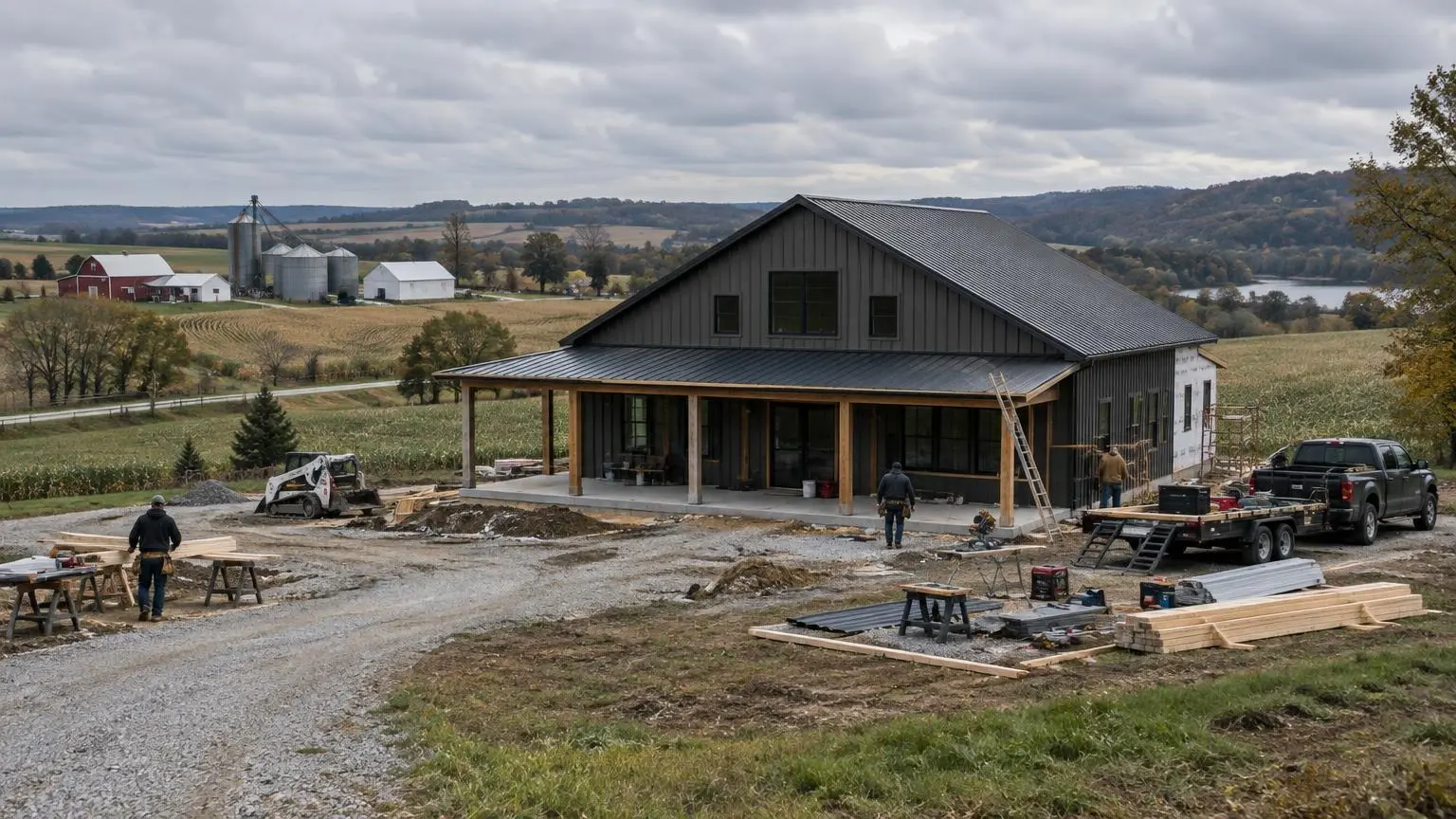
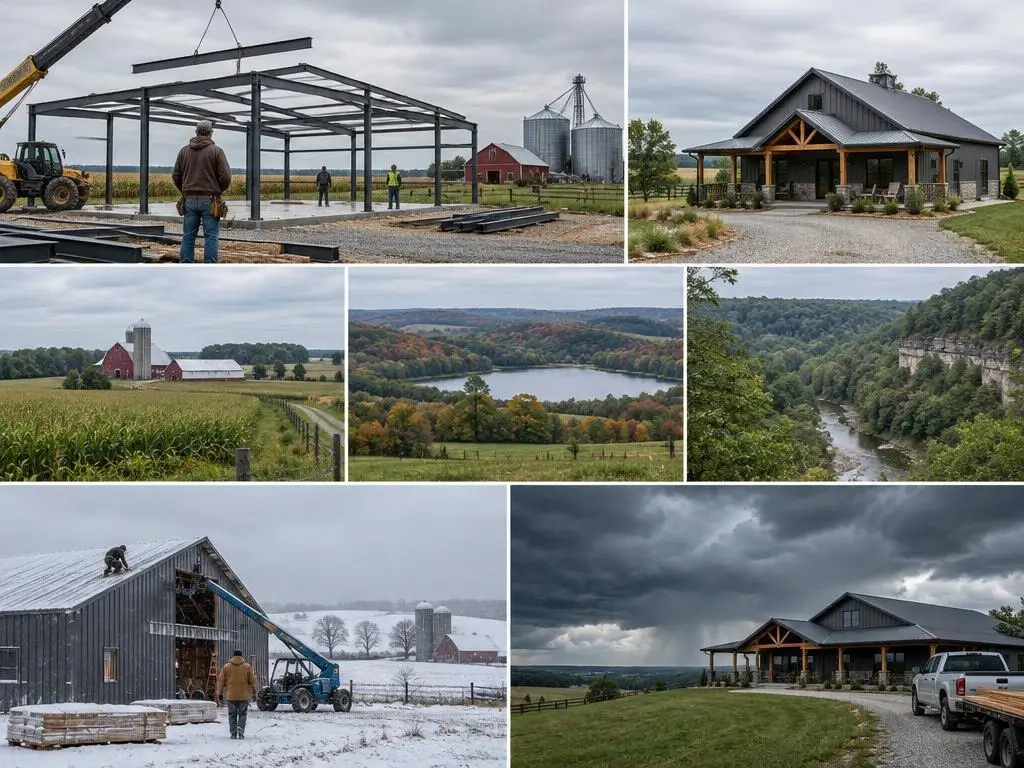
Barndominium builders in Plymouth are working in one of the more rural corners of northern Indiana. Plymouth has been the Marshall County seat since 1836 and had 10,214 residents in 2020, but the county around it is 73.4 percent rural by census count. Wikipedia describes low, rolling hills mostly used for farming, with wooded drainages between them. Plymouth itself straddles the Yellow River, which crosses the county from northeast to southwest. Put together, that means plenty of farm parcels and wooded lots within a short drive of town, plus a handful of lakes for buyers who want water nearby.
Reading a Marshall County parcel
Before we sketch a floor plan, we walk the land with a few questions in mind.
Is it near the Yellow River or a drainage? The river and its wooded side drainages are where water goes when it rains hard. A building pad belongs on the upland part of the parcel, and the flood map tells you whether lenders and the county will see the site as floodplain.
How does the soil drain? Much of northern Indiana's farm ground formed in glacial till with a thin loess cap. Two USDA soil series show the pattern: Morley, with its type location in Adams County, Indiana, and Markham, which ranges across northern Indiana and Illinois. Both are moderately well drained and carry a perched water table about 2 to 3.5 feet down in spring. Morley adds dense till 20 to 40 inches below the surface. On soils like these we plan perimeter drainage, a raised pad and a septic layout that respects the seasonal water table.
Where is the high ground? The county's highest points are three roughly equal swells near 900 feet along the Fulton County line. Most parcels are gentler, but even a few feet of rise is worth using.
Lake parcels: Maxinkuckee and beyond
Lake Maxinkuckee, in the southwest part of the county with Culver on its northwest shore, covers about 1,864 acres and reaches 88 feet deep. Wikipedia calls it Indiana's second-largest natural lake. Lake of the Woods sits in the northeast part of the county and part of Koontz Lake in the northwest, and the Tippecanoe River flows through the southeast. Lake and river parcels tend to bring tighter setbacks, flood questions and septic limits, so they get a closer look up front.
Septic is the norm out here
With most of the county rural, most barndominiums will rely on a septic system and a private well. Indiana's rule for residential onsite sewage systems is 410 IAC 6-8.3, and local health departments, here the Marshall County Health Department, issue the permits. The state program lists alternatives such as elevated sand mounds and aerobic treatment units where a standard trench field will not fit, and it allows holding tanks only temporarily, for up to two years. If you are buying land, a soil evaluation before closing protects you from surprises.
Weather the code plans for
Plymouth's 1991-2020 normals show about 54.9 inches of snow and 40.26 inches of precipitation a year, with a record high of 109 F and a record low of -22 F. The 2020 Indiana Residential Code table lists Marshall County at a 30 psf ground snow load, 115 mph design wind, a 1 F winter design temperature and an air freezing index of 2000, and it sets the minimum footing depth at 36 inches below finished grade. Ice barrier underlayment is required. For a barndominium, those values decide:
- How deep the posts or frost walls go
- Truss, rafter and purlin sizing for snow and drift
- Insulation thickness and vapor control on a metal skin
- Heating equipment size for both the house and any heated shop bay
A steady, not booming, market
Marshall County's population dipped about 2 percent from 2010 to 2020, to 46,095, while Plymouth held roughly steady. About 76 percent of occupied homes in the county are owner-occupied. A quieter land market can make it easier to find acreage, though appraisers may have fewer recent barndominium sales to compare against, so it pays to talk to your lender early about how the home will be valued.
Have a parcel near Plymouth or Culver? Call (317) 893-3806 or
.Marshall County Snapshot
- Mostly rural. 73.4 percent of Marshall County residents lived in rural areas at the 2020 census.
- Yellow River town. Plymouth sits on both banks of the Yellow River, which crosses Marshall County from northeast to southwest.
- Lake Maxinkuckee. Indiana's second-largest natural lake covers about 1,864 acres and reaches 88 feet deep, with Culver on its northwest shore.
- Snow and footings. Plymouth averages about 54.9 inches of snow; the code table lists Marshall County at 30 psf snow and 36-inch minimum footings.
- County seat since 1836. Plymouth became the Marshall County seat when the county formed in 1836 and had 10,214 residents in 2020.
Our Services in Plymouth, IN
Plymouth Questions
Is there farmland near Plymouth for a barndominium?
Yes. Most of Marshall County is rural farm ground on low rolling hills. The work is in picking the right spot on the parcel for drainage, septic and access.
Can I put a barndo on a lot near Lake Maxinkuckee?
Possibly. Lake parcels bring setback, flood and septic questions that farm parcels do not. We review the lot and the local rules before design.
What if my land is too wet for a regular septic field?
Indiana allows alternatives such as elevated sand mounds and aerobic treatment units. Holding tanks are allowed only temporarily, for up to two years, so they are not a permanent answer.
Will a lender appraise a barndominium in Marshall County?
Many do, but comparable sales can be thin in a slower market. Talk to your lender early. A well-documented plan and spec sheet helps the appraiser.
Barndominium Builders Near Plymouth
- Barndominium Builders in Indianapolis, IN
- Barndominium Builders in Noblesville, IN
- Barndominium Builders in Westfield, IN
- Barndominium Builders in Greenwood, IN
- Barndominium Builders in Franklin, IN
- Barndominium Builders in Martinsville, IN
- Barndominium Builders in Bloomington, IN
- Barndominium Builders in Columbus, IN
- Barndominium Builders in Seymour, IN
- Barndominium Builders in Shelbyville, IN
- Barndominium Builders in Greenfield, IN
- Barndominium Builders in Anderson, IN
- Barndominium Builders in Muncie, IN
- Barndominium Builders in Richmond, IN
- Barndominium Builders in Kokomo, IN
- Barndominium Builders in Lafayette, IN
- Barndominium Builders in Crawfordsville, IN
- Barndominium Builders in Terre Haute, IN
- Barndominium Builders in Vincennes, IN
- Barndominium Builders in Evansville, IN
- Barndominium Builders in Jasper, IN
- Barndominium Builders in New Albany, IN
- Barndominium Builders in Fort Wayne, IN
- Barndominium Builders in Auburn, IN
- Barndominium Builders in Warsaw, IN
- Barndominium Builders in Goshen, IN
- Barndominium Builders in Elkhart, IN
- Barndominium Builders in South Bend, IN
- Barndominium Builders in Valparaiso, IN