
The Summit City at Three Rivers
Barndominium Builders in Fort Wayne, IN
Indiana's largest county by area has a well-documented permit path. Here it is, in the order it happens.
- Site visit before any pricing
- Written, line-item estimates
- County code and septic research included
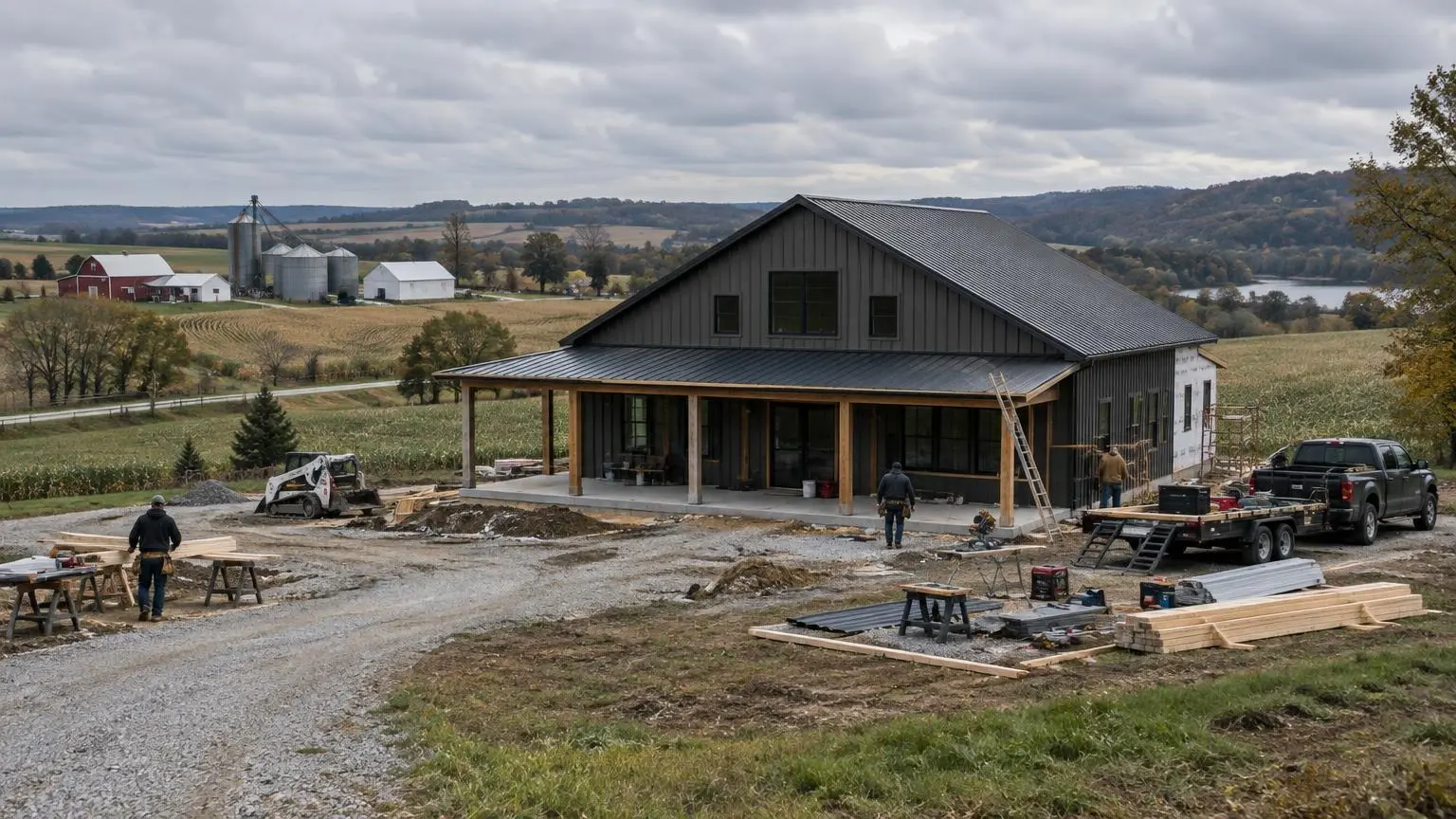
The Allen County Path to a Barndominium
Barndominium builders in Fort Wayne benefit from one thing in particular: Allen County lays out its residential permit steps in public. Fort Wayne is the county seat, at the meeting of the St. Joseph and St. Marys rivers where they form the Maumee. The city had 263,886 residents at the 2020 census, and Allen County, at about 660 square miles the largest county in Indiana, grew from 355,329 in 2010 to 385,410 in 2020. Outside the city, the county also includes smaller towns such as Huntertown, Leo-Cedarville, Grabill, Monroeville and Woodburn as well as unincorporated land.
Below is the order things happen, based on what the county's Department of Planning Services, Building Department, Surveyor and Department of Health publish.
Step 1: Before you buy
The Allen County Department of Health says some sites in the county are not suitable for on-site wastewater treatment, and it strongly recommends hiring a soil scientist and a septic designer to review a parcel before buying it. The soil scientist must be registered with the Indiana Department of Health and the Indiana Registry of Soil Scientists. The Department of Planning Services (DPS) can also confirm a parcel's zoning, permitted uses, development standards and history, and it offers free New Projects Meetings.
Step 2: Splitting land, if you need to
If you are buying part of a larger farm, DPS first checks whether the land is platted or unplatted. Parcels under 20 acres can generally be split once every 12 months if they meet development standards. Land with no road frontage in unincorporated Allen County or Huntertown may be able to use a county-approved roadway easement.
Step 3: Get the address
Unplatted land needs a new address. DPS assigns addresses in most of the county, including Fort Wayne and Huntertown, while Leo-Cedarville and New Haven handle their own. The county says to use the DPS-assigned address on every application to other departments.
Step 4: Septic permit
The Health Department's Environmental Services Division issues permits and conducts inspections for all new on-site sewage systems, under 410 IAC 6-8.3 and the Allen County Private Sewage Disposal Ordinance.
Step 5: Floodplain review
The Allen County Surveyor is the county's floodplain administrator. The Surveyor reviews and permits development in unincorporated Allen County and, since September 1, 2025, in Grabill, Huntertown, Leo-Cedarville, Monroeville and Woodburn. Fort Wayne floodplains stay with DPS, and New Haven handles its own. The current FEMA maps are dated January 11, 2024. Floodway work also needs an Indiana DNR permit, and the county notes that a DNR exemption is not an exemption from local review. Under the state residential code, a home in a flood hazard area is built to base flood elevation plus two feet.
Step 6: Planning permit
A single-family home needs a Single-Family Residential permit with a plot plan, which can be drawn in the county's iMap tool. Applications go through the Citizen Access portal or in person at DPS, and the county targets 3 to 5 business days for administrative permits like these.
Step 7: Building permit and occupancy
After DPS issues its permit, the Allen County Building Department handles the building permit, inspections and certificate of occupancy under the Indiana Residential Code.
The ground: an old lake bottom
Wikipedia notes that Fort Wayne's flat terrain is a product of Wisconsin glaciation. The Fort Wayne Moraine follows the St. Marys and St. Joseph rivers, and land east of it includes the former Great Black Swamp, a lake plain left by glacial Lake Maumee. Soils on those wave-worked flats include Hoytville, which the USDA describes as very poorly drained clayey till on 0 to 1 percent slopes, mapped in northeastern Indiana, with a perched water table from a foot above to a foot below the surface, typically January through April. On moraine ground, Glynwood is common across northern Indiana: moderately well drained, with slow permeability and a perched water table 1 to 2 feet down in late winter and spring. On wet flats, expect drain tile, a raised pad and careful septic design.
Frost and snow
The 2020 Indiana Residential Code lists Allen County at a 36-inch footing depth, deeper than the 30 inches listed for Montgomery County or the 24 inches for Vanderburgh, plus a 20 psf ground snow load, a 1 F winter design temperature, an air freezing index of 2000 and a requirement for ice-barrier underlayment. Fort Wayne averages about 33.6 inches of snow, and its record low is -24 F from January 1918. Rivers flood too: the 1913 flood left 15,000 people homeless, and the 1982 flood forced 9,000 to evacuate.
Have land in Allen County? Call (317) 893-3806 or
and we'll start at Step 1.Allen County Permit Facts
- Septic first. The Allen County Department of Health recommends a soil scientist and septic designer review land before purchase; some sites are not suitable for septic.
- Floodplain administrator. The Allen County Surveyor reviews floodplain development in unincorporated areas and, since Sept. 1, 2025, five small towns.
- Permit timing. DPS targets 3 to 5 business days for administrative single-family residential permits.
- Deep footings. Allen County is listed at a 36-inch footing depth with ice-barrier underlayment required in the 2020 Indiana Residential Code.
- Lake plain. East of the Fort Wayne Moraine lies the former Great Black Swamp, a lake plain left by glacial Lake Maumee.
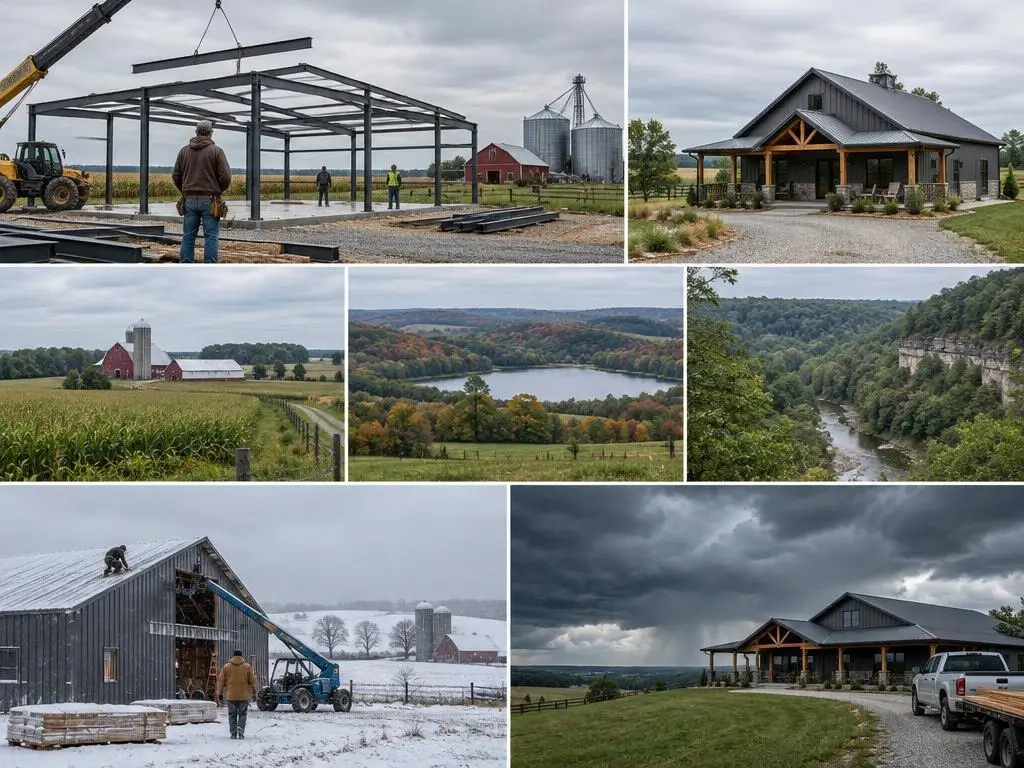
Our Services in Fort Wayne, IN
Fort Wayne Questions
Should I get a soil test before buying land in Allen County?
Yes. The county health department says some sites aren't suitable for septic and recommends a soil scientist and septic designer review the parcel before purchase.
Who handles floodplain review near Huntertown or Grabill?
Since September 1, 2025, the Allen County Surveyor reviews floodplain development there, as it does in unincorporated Allen County.
How long does the planning permit take?
The county targets 3 to 5 business days for administrative single-family permits, once the application is complete.
Why are footings deeper here than in southern Indiana?
The state code lists Allen County at 36 inches because of colder winters and a higher freezing index. Southern counties like Vanderburgh are listed at 24.
Barndominium Builders Near Fort Wayne
- Barndominium Builders in Indianapolis, IN
- Barndominium Builders in Noblesville, IN
- Barndominium Builders in Westfield, IN
- Barndominium Builders in Greenwood, IN
- Barndominium Builders in Franklin, IN
- Barndominium Builders in Martinsville, IN
- Barndominium Builders in Bloomington, IN
- Barndominium Builders in Columbus, IN
- Barndominium Builders in Seymour, IN
- Barndominium Builders in Shelbyville, IN
- Barndominium Builders in Greenfield, IN
- Barndominium Builders in Anderson, IN
- Barndominium Builders in Muncie, IN
- Barndominium Builders in Richmond, IN
- Barndominium Builders in Kokomo, IN
- Barndominium Builders in Lafayette, IN
- Barndominium Builders in Crawfordsville, IN
- Barndominium Builders in Terre Haute, IN
- Barndominium Builders in Vincennes, IN
- Barndominium Builders in Evansville, IN
- Barndominium Builders in Jasper, IN
- Barndominium Builders in New Albany, IN
- Barndominium Builders in Auburn, IN
- Barndominium Builders in Warsaw, IN
- Barndominium Builders in Goshen, IN
- Barndominium Builders in Elkhart, IN
- Barndominium Builders in South Bend, IN
- Barndominium Builders in Plymouth, IN
- Barndominium Builders in Valparaiso, IN