
On the Wabash, across from Purdue
Barndominium Builders in Lafayette, IN
Dark prairie soil, a big river and a busy tornado record. Here is how they shape a barndo near Lafayette.
- Site visit before any pricing
- Written, line-item estimates
- County code and septic research included
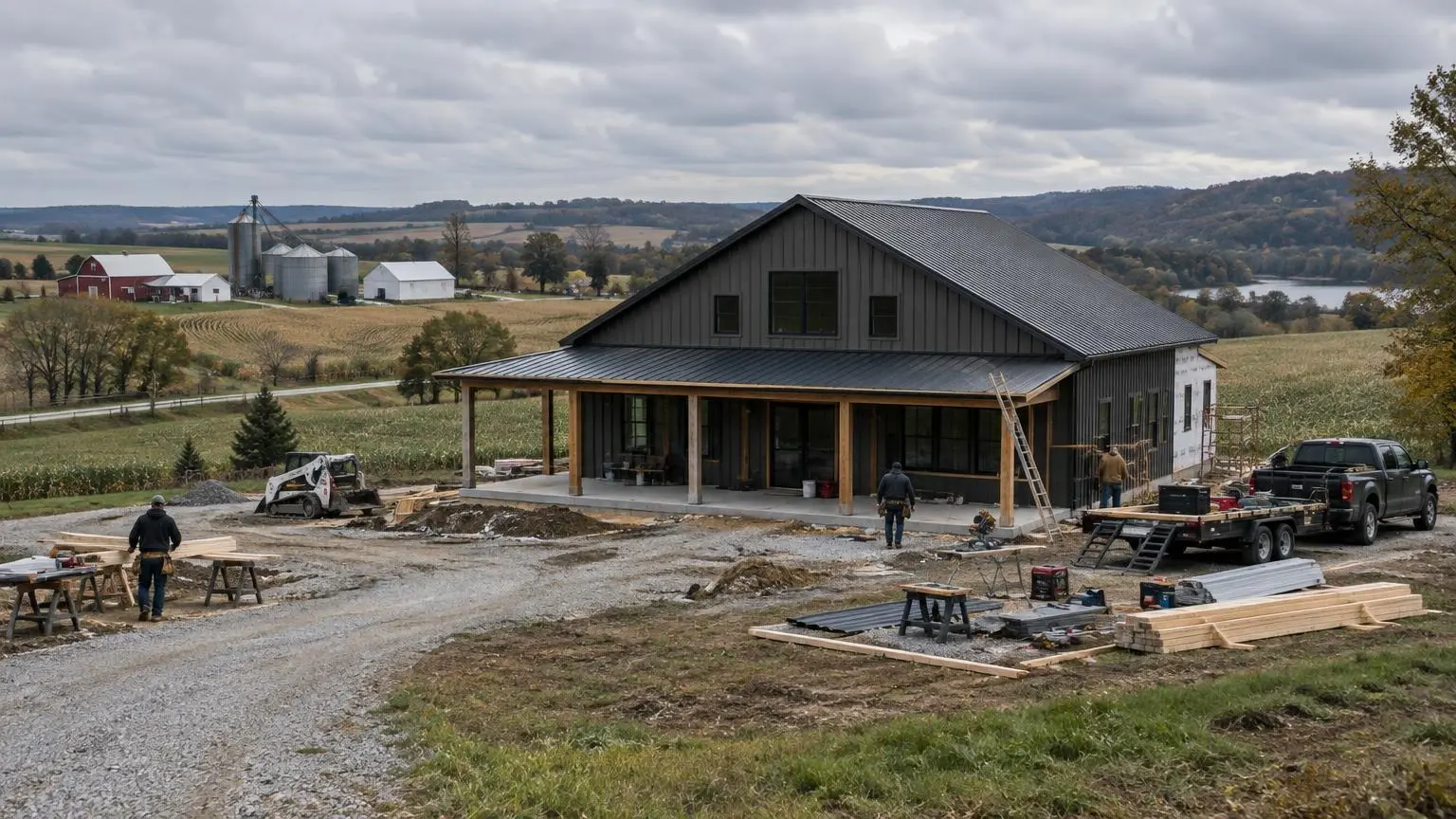
Tippecanoe County, From the Ground Up
Barndominium builders in Lafayette work in one of Indiana's growing counties. Lafayette, the Tippecanoe County seat, sits on the southeast bank of the Wabash River across from West Lafayette and Purdue University, 63 miles northwest of Indianapolis and 125 miles southeast of Chicago. The city grew from 67,140 in 2010 to 70,783 in 2020, and the county from 172,780 to 186,251, with a 2025 estimate over 190,000. Employers such as Subaru of Indiana Automotive and Caterpillar keep demand steady. Outside the two cities, the county's 500 square miles hold towns like Battle Ground, Dayton, Clarks Hill and Stockwell, with farm ground between them.
Prairie soils: rich and wet
Northwestern Indiana has large areas of dark prairie soils. Drummer is the classic example. The USDA lists it as common in northern and central Illinois and northwestern Indiana, formed in 40 to 60 inches of loess over stratified outwash on nearly level or depressional ground. It is poorly drained: the water table can sit from half a foot above the surface to a foot below it in spring, and water ponds briefly. That is great for corn and hard on a building pad. On a parcel like that:
- The house and shop pad should be built up with compacted fill
- Perimeter drain tile and positive grading are not optional
- Field tile already on the farm should be located and protected or rerouted
- The septic site needs a soil evaluation and may need an engineered system
The Wabash and the bluffs
Lafayette sits at 663 feet, well below Kokomo or Muncie, because it is in the Wabash valley. River land and creek bottoms carry flood zones; the higher ground above the valley is drier but can be steep near the edge. The county's highest point is in Lauramie Township, in the southeast. If you are looking at wooded land overlooking the river, plan for slope, access and runoff along with the view.
A long tornado record
The National Weather Service lists 55 tornadoes in Tippecanoe County from 1950 through 2025, about twice the count for Howard County. Three were rated F4: April 11, 1965, March 20, 1976, and April 26, 1994 at Lafayette, which killed 3 people and injured 70. An EF3 hit near North Crane on November 17, 2013. The 2020 Indiana Residential Code sets a 115 mph design wind speed for the county, with exposure decided per site. Flat prairie is open country, so we design the anchors, frames and connections for high exposure and recommend an interior shelter space.
Cold, snow and footings
The code table lists Tippecanoe County at a 30-inch minimum footing depth, a 20 psf ground snow load, seismic category A and an air freezing index of 2,000, higher than the counties around Indianapolis. Lafayette's records run from 106 F (July 1954) to -25 F, with about 39.83 inches of precipitation and 20.5 inches of snow a year. In a metal-skinned barndominium, that cold is handled with continuous insulation, a sealed air barrier and insulated slab edges in heated rooms.
Septic outside the cities
On land beyond Lafayette and West Lafayette sewer service, a septic permit comes from the local health department under Indiana's residential rule, 410 IAC 6-8.3. Poorly drained prairie soils can rule out a standard trench system, so get a soil evaluation from a registered soil scientist early. Where a sewer line is close enough, the state requires connection instead.
What gets permitted
Indiana Code 22-12-1-5 treats a one- or two-family dwelling and its outbuildings, garage or barn included, as a Class 2 structure. Your barndominium is a house in the eyes of the code even when the shop is the larger half. Whether a city, a town or the county reviews it depends on where the parcel sits, so that is the first thing we check.
Floor plan ideas that fit the area
With Purdue across the river and agriculture all around, a barndominium layout can include a shop sized for farm or hobby equipment, an office for remote work, and a guest suite or second unit where zoning allows it.
Have land near Lafayette, Battle Ground or Dayton? Call (317) 893-3806 or
.Tippecanoe County Notes
- 55 tornadoes. NWS records 55 tornadoes in Tippecanoe County from 1950 to 2025, including an F4 at Lafayette on April 26, 1994.
- Prairie soil. Drummer soils, common in northwestern Indiana, are poorly drained and pond briefly in spring.
- Code values. Tippecanoe County: 115 mph wind, 20 psf snow, 30-inch footings, air freezing index 2,000.
- Growth. The county grew from 172,780 in 2010 to 186,251 in 2020.
- Wabash valley. Lafayette sits at 663 feet on the southeast bank of the Wabash River, across from West Lafayette.
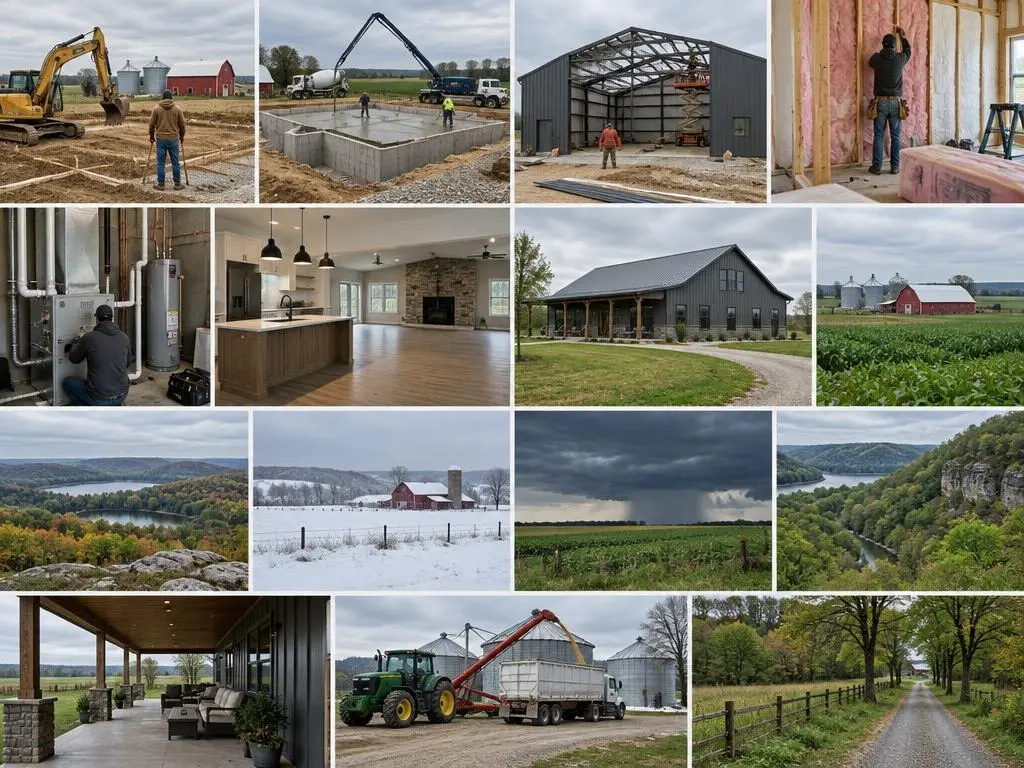
Our Services in Lafayette, IN
Lafayette Questions
My land has dark prairie soil that ponds in spring. Can I build?
Yes, with preparation. We build the pad up with compacted fill, add drain tile and grade the site, and the septic design follows the soil evaluation.
Why does Tippecanoe County have so many tornadoes on record?
We can only tell you what the record shows: 55 tornadoes since 1950, including three F4s. That is why we design for high wind exposure and suggest a shelter space.
Can I build on a bluff above the Wabash?
Often. We check the slope near the edge, the access road and where runoff goes, and keep the building back from steep ground.
How deep do footings go near Lafayette?
The 2020 Indiana Residential Code lists a 30-inch minimum for Tippecanoe County, measured from finished grade.
Barndominium Builders Near Lafayette
- Barndominium Builders in Indianapolis, IN
- Barndominium Builders in Noblesville, IN
- Barndominium Builders in Westfield, IN
- Barndominium Builders in Greenwood, IN
- Barndominium Builders in Franklin, IN
- Barndominium Builders in Martinsville, IN
- Barndominium Builders in Bloomington, IN
- Barndominium Builders in Columbus, IN
- Barndominium Builders in Seymour, IN
- Barndominium Builders in Shelbyville, IN
- Barndominium Builders in Greenfield, IN
- Barndominium Builders in Anderson, IN
- Barndominium Builders in Muncie, IN
- Barndominium Builders in Richmond, IN
- Barndominium Builders in Kokomo, IN
- Barndominium Builders in Crawfordsville, IN
- Barndominium Builders in Terre Haute, IN
- Barndominium Builders in Vincennes, IN
- Barndominium Builders in Evansville, IN
- Barndominium Builders in Jasper, IN
- Barndominium Builders in New Albany, IN
- Barndominium Builders in Fort Wayne, IN
- Barndominium Builders in Auburn, IN
- Barndominium Builders in Warsaw, IN
- Barndominium Builders in Goshen, IN
- Barndominium Builders in Elkhart, IN
- Barndominium Builders in South Bend, IN
- Barndominium Builders in Plymouth, IN
- Barndominium Builders in Valparaiso, IN