
Crossroads of Southern Indiana
Barndominium Builders in Seymour, IN
Flat lowland, a slow river and a county that is close to half rural. Here is what that means for a barndo.
- Site visit before any pricing
- Written, line-item estimates
- County code and septic research included
What Jackson County Land Asks of a Barndominium
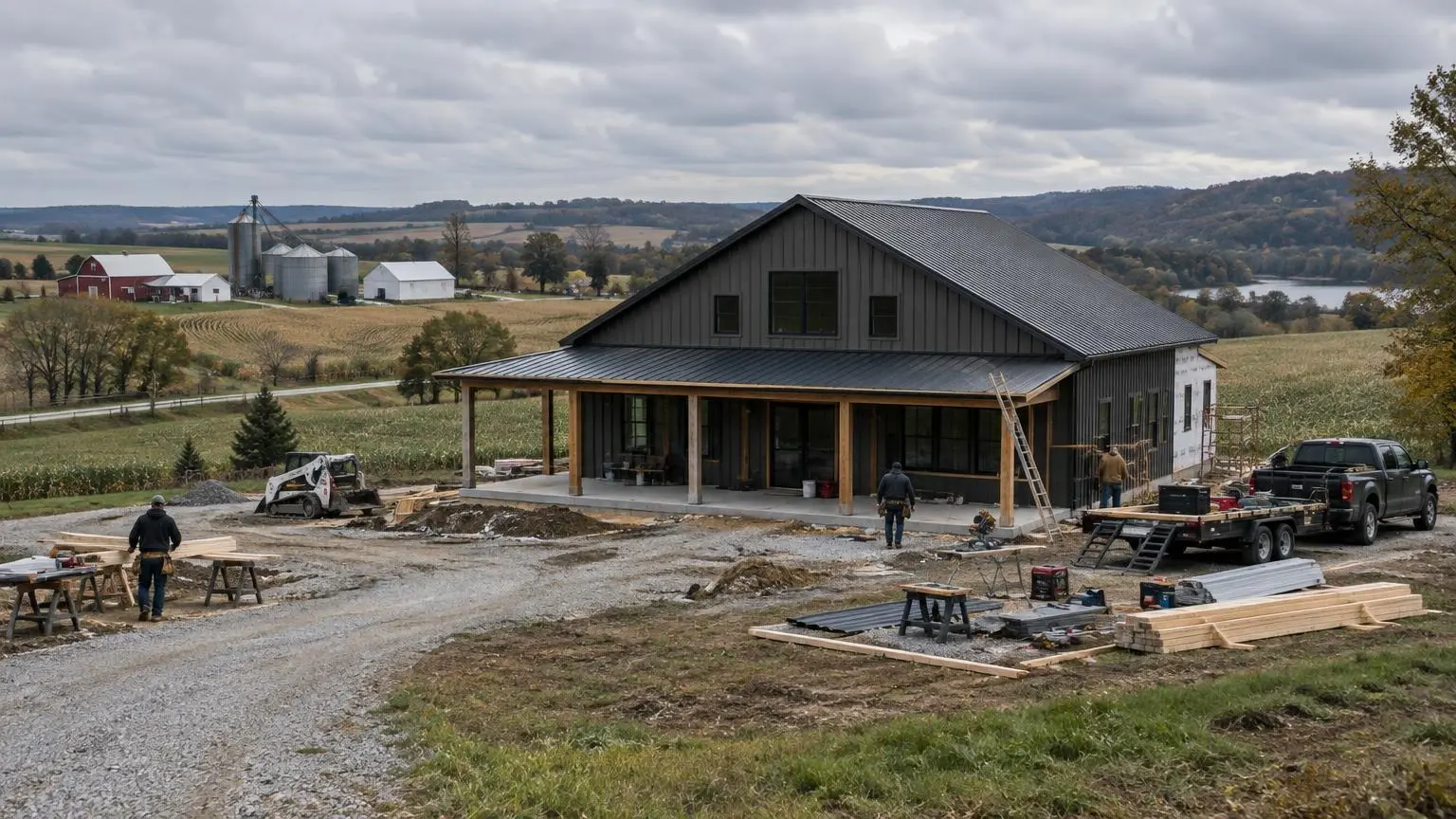
Barndominium builders in Seymour work on a relatively flat stretch of southern Indiana, and that flatness is both the appeal and the catch. Seymour is the largest city in Jackson County, about 62 miles south of Indianapolis and about 55 miles north of Louisville. It grew from 17,503 residents in 2010 to 21,569 in 2020, and the county around it went from 42,376 to 46,428 over the same decade. Close to half of county residents (47.8 percent) live in rural areas, so open parcels for a house-and-shop building are not hard to find. The questions are about water, soil and footings, and they are easier to answer before you close on land than after.
Start with the river
The East Fork of the White River dominates the landscape around Seymour. It is a slow, silted, meandering river that averages 19 days above flood stage a year, and at least three major floods have been recorded since 1900. The Great Flood of 1913 is still counted as the deadliest natural disaster in the area. For a barndominium, that history turns into a simple rule: pull the flood map for the parcel before you settle on a pad location. Bottomland that floods a few weeks a year can still be fine for hay or pasture, with the house and shop set on higher ground and the driveway planned so you can get out when the river is up.
A low, flat landscape
Seymour sits in the Scottsburg Lowland, which the Indiana Geological and Water Survey describes as a low-relief landscape formed because its shale bedrock erodes easily. Just west, the ground changes fast: the Knobstone Escarpment is a winding ridge of steep-sided hills and valleys running from northern Brown County to the Ohio River, and behind it lies the Norman Upland. Parts of the Hoosier National Forest and the Muscatatuck National Wildlife Refuge reach into Jackson County. So depending on which direction you drive from Seymour, a building site might be dead-level farm ground or a wooded slope that needs a cut-and-fill pad.
The soil under a flat lot
One soil series worth knowing here is Avonburg. Its official USDA description sets the type location in neighboring Scott County and calls it a soil of large extent in southeastern Indiana. Avonburg is somewhat poorly drained, formed in 60 to 90 inches of loess over an older buried soil in Illinoian till, and has a dense, brittle layer starting 20 to 40 inches down. A perched water table sits 0.5 to 1.5 feet below the surface in normal years. That combination is why we pay attention to:
- Pad height and final grade, so water moves away from the slab
- Perimeter drain tile where the site calls for it
- Gutters and downspouts carried well clear of the building
- Septic design, since a shallow seasonal water table limits what a soil test will allow
Footings: shallower than central Indiana
The county table in the 2020 Indiana Residential Code lists Jackson County at a 24-inch minimum footing depth, measured from finished grade to the bottom of the footing. Shelby, Hancock and other counties closer to Indianapolis are listed at 30 inches. The same table puts Jackson County at a 20 psf ground snow load, 115 mph design wind speed, seismic design category B and a 9 F winter design temperature. Those numbers feed directly into the slab edge, post embedment or pier design for a steel or post-frame barndominium.
Wind and tornadoes
The National Weather Service records 23 tornadoes in Jackson County from 1950 through 2025, including an F4 on June 2, 1990 and F3 tornadoes in 1974 and 1976. Wind exposure is decided site by site under the code, and an open field near Seymour is about as exposed as Indiana gets. We detail roof-to-wall and wall-to-foundation connections for the actual exposure, not a generic one, and a safe room or reinforced interior space is worth including in the floor plan.
Septic and permits
Indiana's residential onsite sewage rule is 410 IAC 6-8.3, and local health departments issue the permits. Where a sanitary sewer is close enough, the state program says an onsite system is prohibited and the home must connect, so lots near Seymour's edge may be sewer lots while lots out in the townships will be septic lots. State law treats a one- or two-family dwelling and its outbuildings, including a garage or barn, as a Class 2 structure. Whether your plans go to a city or county office depends on where the parcel sits, so we confirm jurisdiction first.
Climate notes
Seymour's records run from 113 F in July to -22 F in January, with about 41.9 inches of precipitation and 16.9 inches of snow a year. Hot, humid summers make condensation control inside a metal shell a real design item: closed-cell spray foam or a continuous vapor-controlled assembly, plus HVAC sized for the space.
Have a parcel picked out around Seymour, Brownstown or Crothersville? Call (317) 893-3806 or
and send the parcel number.Seymour and Jackson County at a Glance
- River flooding. The East Fork White River averages 19 days above flood stage per year; the 1913 flood crested 27.50 feet.
- Footing depth. The 2020 Indiana Residential Code lists Jackson County at a 24-inch minimum footing depth, 20 psf snow and 115 mph wind.
- Avonburg soil. Somewhat poorly drained loess soil of large extent in southeastern Indiana, with a perched water table at 0.5 to 1.5 feet.
- Tornado record. 23 tornadoes recorded in Jackson County from 1950 through 2025, including an F4 in June 1990.
- Rural county. 47.8 percent of Jackson County residents live in rural areas; the county grew to 46,428 people in 2020.

Our Services in Seymour, IN
Seymour Questions
How do I know if my land near the East Fork floods?
Check the parcel against the FEMA flood map and the county's flood records before buying. The river averages 19 days above flood stage a year, so low ground near it deserves a careful look. We set the building pad on the high part of the parcel.
Are footings really shallower in Jackson County?
Yes. The 2020 Indiana Residential Code table lists 24 inches for Jackson County, compared with 30 inches in counties around Indianapolis. Your engineered plans set the final depth.
Will Avonburg-type soil pass a septic test?
It depends on the specific spot. Soils with a shallow perched water table limit conventional trenches, so the health department may require an alternative system. A soil evaluation tells you before you commit.
Can I build on wooded ground west of Seymour?
Often, yes. Toward the Knobstone Escarpment the land gets steeper, which means more site work for the pad and driveway. We look at slope and access on the first visit.
Free Estimates in Seymour, IN
Talk through your Jackson County parcel.
Barndominium Builders Near Seymour
- Barndominium Builders in Indianapolis, IN
- Barndominium Builders in Noblesville, IN
- Barndominium Builders in Westfield, IN
- Barndominium Builders in Greenwood, IN
- Barndominium Builders in Franklin, IN
- Barndominium Builders in Martinsville, IN
- Barndominium Builders in Bloomington, IN
- Barndominium Builders in Columbus, IN
- Barndominium Builders in Shelbyville, IN
- Barndominium Builders in Greenfield, IN
- Barndominium Builders in Anderson, IN
- Barndominium Builders in Muncie, IN
- Barndominium Builders in Richmond, IN
- Barndominium Builders in Kokomo, IN
- Barndominium Builders in Lafayette, IN
- Barndominium Builders in Crawfordsville, IN
- Barndominium Builders in Terre Haute, IN
- Barndominium Builders in Vincennes, IN
- Barndominium Builders in Evansville, IN
- Barndominium Builders in Jasper, IN
- Barndominium Builders in New Albany, IN
- Barndominium Builders in Fort Wayne, IN
- Barndominium Builders in Auburn, IN
- Barndominium Builders in Warsaw, IN
- Barndominium Builders in Goshen, IN
- Barndominium Builders in Elkhart, IN
- Barndominium Builders in South Bend, IN
- Barndominium Builders in Plymouth, IN
- Barndominium Builders in Valparaiso, IN